How Conversation Became the Next Design Interface
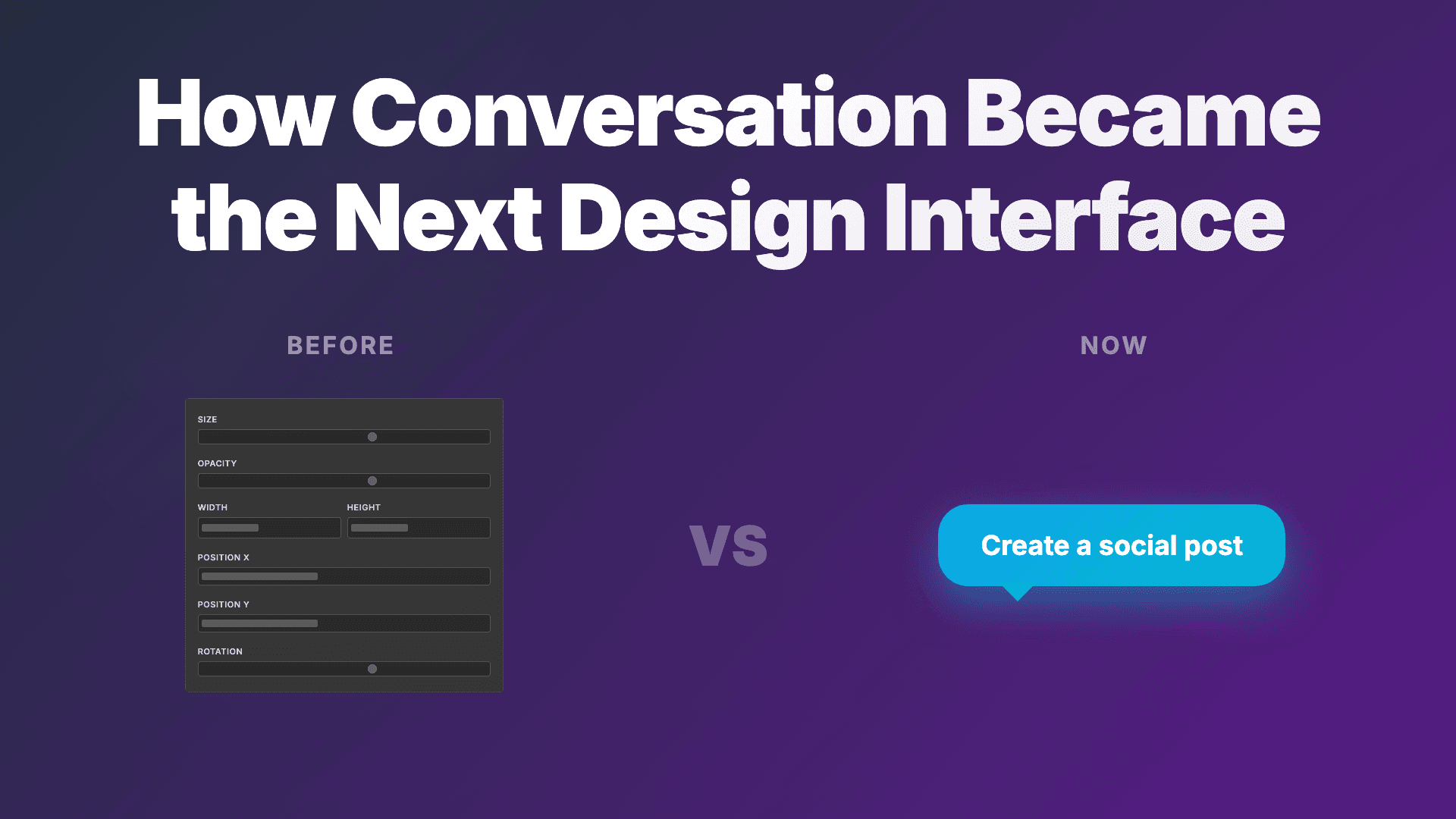
You don't open Photoshop to talk. You learn layers, masks, blend modes. You master the pen tool. You memorize keyboard shortcuts. For decades, this was the contract: if you want to design, you learn the tool's language first.
But here's what nobody said out loud: the interface became the barrier.
When Tools Speak Their Own Language
Most design tools are built for designers. That makes sense — until you realize the majority of people creating marketing visuals aren't designers at all. They're founders writing tweets at midnight. Marketers juggling five campaigns. Content creators who know exactly what they want but can't translate vision into Bezier curves.
The gap isn't creativity. It's translation.
You can describe the image in your head perfectly: "A clean LinkedIn post with our logo, three bullet points about our product launch, and a gradient background in our brand colors." But to execute that in a traditional tool, you navigate menus, adjust alignment, hunt for the right shade of blue, wrestle with text boxes, export at the wrong resolution, and start over.
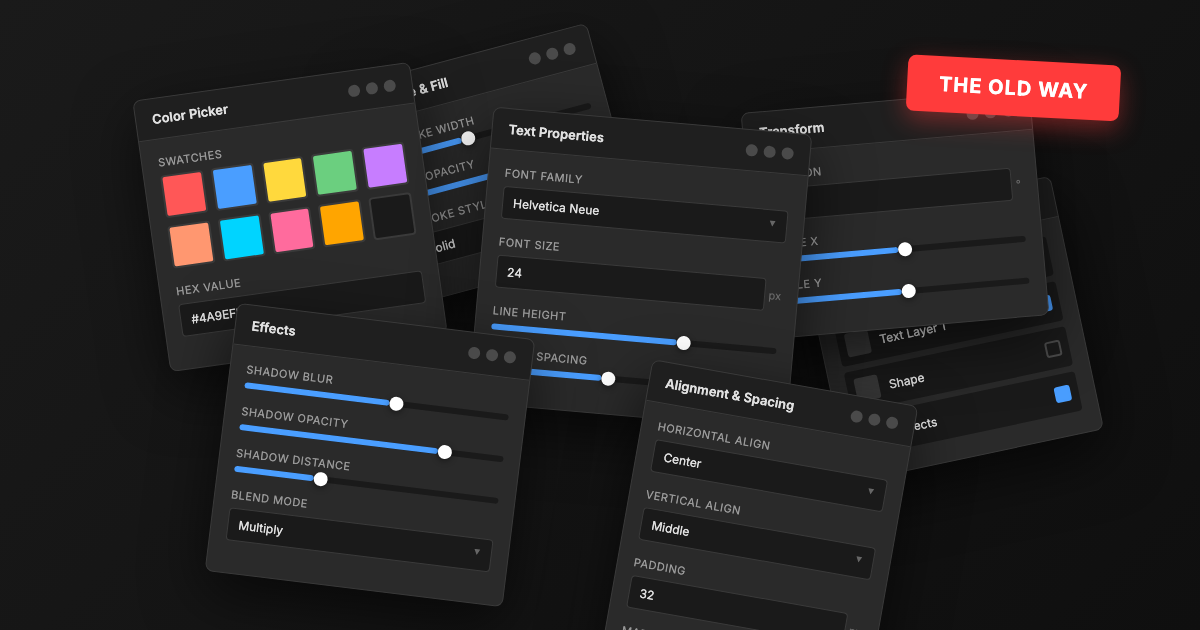
The tool demanded you learn its grammar. But what if the tool learned yours?
The Paradigm Nobody Saw Coming
In 2022, something shifted. ChatGPT launched, and suddenly millions of people were conversing with software. Not clicking. Not dragging. Not memorizing shortcuts. Just... talking.
The effect was subtle at first. People used it for writing, for answering questions, for brainstorming. But beneath the surface, a new expectation was forming: software should understand intent, not just commands.
This wasn't just a better chatbot. It was a new interface paradigm.
And design tools? They were still speaking Photoshop.
Why Conversation Works for Creation
Language is humanity's oldest creative tool. Before canvases, before chisels, before code — we had words. We described what we imagined, and others brought it to life.
When we built 0layers, we realized most design tools treat your idea like an attachment, not the starting point. You're expected to translate vision into tool mechanics before anything appears on screen. It's backwards.
Conversation inverts that.
Instead of:
- Open tool → 2. Find template → 3. Adjust layers → 4. Export
You get:
- Describe what you need → 2. It appears
The creative leap isn't gone — it's just placed where it belongs: in your head, not in menu navigation.
Here's what conversation unlocks that canvases can't:
Iteration feels like dialogue, not rework. "Make the headline bolder" is faster than finding the text layer, selecting it, opening the font panel, adjusting weight, and re-aligning.
Brand context persists. You say "use our colors" once. The tool remembers. You're not re-uploading your logo for the 47th time this month.
Ambiguity is allowed. "Make it feel more professional" is vague — but humans understand vibes. A conversational tool can interpret tone, iterate, and ask clarifying questions if needed.
Non-designers can create. If you can describe it, you can make it. The translation barrier disappears.

From Commands to Intent
Traditional design tools operate on commands: click this, drag that, apply this filter. Every action is explicit. You're the pilot, and the software is the plane — it goes exactly where you steer it.
Conversational design tools operate on intent: I need a social post for LinkedIn about our product launch, clean and professional, with our branding.
The tool interprets, suggests, executes.
This isn't about removing control — it's about removing friction. You still steer. You still refine. You still make creative decisions. But you're no longer spending cognitive energy on tool mechanics. You're spending it on the work that actually matters: the message, the vibe, the story.
The Creative Founder's New Workflow
Let me show you what this looks like in practice.
Before (Template-First Tools):
- Open design tool
- Search "LinkedIn post template professional"
- Scroll through 200+ templates
- Pick one that's "close enough"
- Replace placeholder text (fonts don't quite match your brand)
- Upload logo (again)
- Adjust colors manually (which hex code was that?)
- Realize the layout doesn't quite fit your message
- Start over or compromise
After (Conversation-First Tools):
- "Create a LinkedIn post announcing our Series A funding. Professional tone, include our logo and brand colors, emphasize our mission to help small businesses scale."
- Design appears in seconds
- "Make the headline bigger and move the logo to the top right"
- Done
The creative decision-making is the same. The interface friction vanished.
What Gets Unlocked
When conversation becomes the interface, something unexpected happens: design becomes iterative by default.
In traditional tools, iteration feels like rework. You duplicate the file, make changes, compare versions, pick one. It's heavy. So you front-load decisions, trying to get it right the first time.
In conversation, iteration is just... talking more.
"Actually, make the background darker." "Add a subtle gradient." "Try the headline in our secondary brand color."
Each adjustment takes seconds. You're not redoing work — you're refining through dialogue. The creative process starts to feel less like manufacturing and more like sculpting through conversation.
And here's the philosophical shift: tools shouldn't just remember your settings — they should remember your style.
When you say "make it more on-brand," a conversational tool should know what that means for you. Not a generic template. Not a best guess. Your actual brand: your colors, your fonts, your tone.
That's not automation. That's memory as a feature.
The Tools That Speak Human
We're watching a turning point. The next generation of creative tools won't ask you to learn their language. They'll learn yours.
This isn't about replacing designers. It's about removing the translation layer between idea and execution for the millions of people who aren't designers but still need to create.
Founders shouldn't need a design degree to launch a campaign. Marketers shouldn't spend 30 minutes navigating menus to make one social post. Small teams shouldn't need three tools and two file formats to maintain brand consistency.
Conversation doesn't dumb down design. It removes the barrier so creativity can flow at the speed of thought.
The Future Speaks Back
Five years from now, we'll look back at pixel-pushing interfaces the way we look at command-line DOS prompts today: powerful, yes, but not how most people want to work.
The best tools disappear. They stop demanding you learn their logic and start understanding yours.
Design won't happen in a tool. It'll happen through conversation.
And when that shift completes, the question won't be "Do you know Photoshop?"
It'll be: "Can you describe what you want to make?"
If the answer is yes — you're a designer now.
Start With a Sentence — The Next Chapter of Design
The future of design isn't about learning better tools. It's about tools that learn you. Want to see what conversational creation feels like? Try 0layers and experience design through conversation.